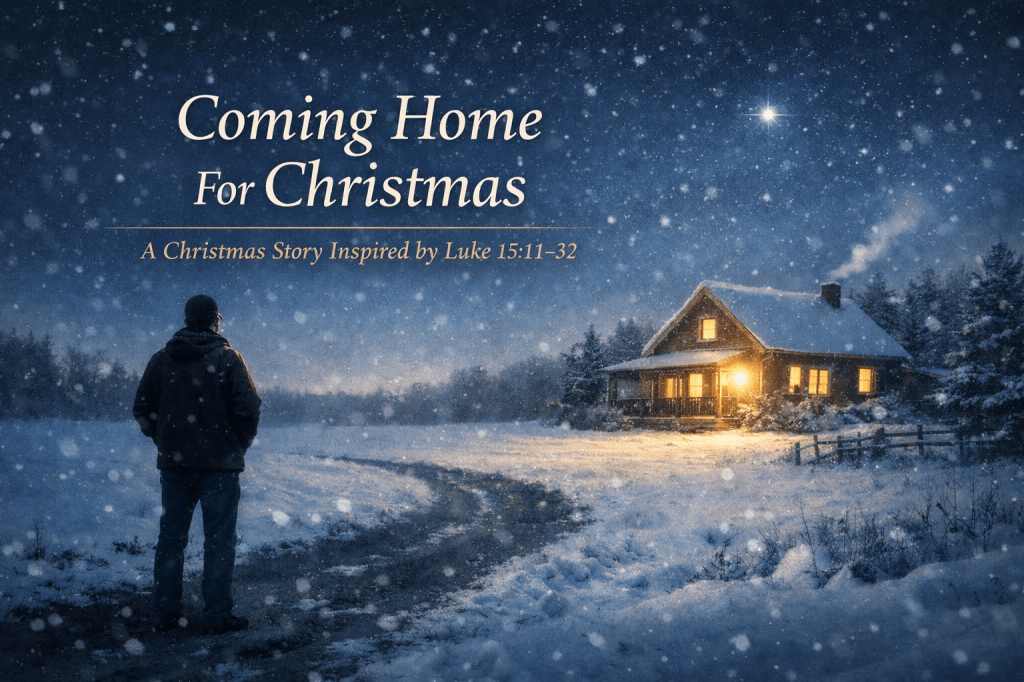
A Christmas Story Inspired by Luke 15:11–32
The snow hadn’t started yet, but everyone in town could feel it coming.
Daniel Harper stood at the edge of his father’s driveway, hands shoved deep into the pockets of his jacket, staring at the old farmhouse like it might speak first. Christmas lights hung along the porch rail—simple white bulbs, nothing flashy. They’d been the same lights for as long as Daniel could remember. His mother used to joke that his dad believed tradition mattered more than trends.
That was the problem, Daniel thought.
Everything here mattered too much.
Inside the house, warmth glowed through the windows. The smell of pine and cinnamon drifted faintly through the cold air when the door opened and closed again. His younger cousins were already there; he could hear laughter, the scrape of chairs, the familiar noise of family settling in for another December night.
Another Christmas that looked exactly like the last.
“Danny?” his father called from the porch. “You coming in, or are you planning to freeze out there?”
Daniel turned slowly. His father, Samuel Harper, stood framed in the doorway, coatless despite the cold, his expression calm and open. He was in his early sixties now, hair more silver than brown, hands worn from years of work that never showed up on a résumé. He had the kind of presence that made people feel seen without being examined.
“I need to talk to you,” Daniel said.
Samuel studied his son for a moment, then nodded. “Alright. Let’s walk.”
They headed down the gravel drive, crunching softly beneath their boots. The fields stretched out on either side, dark and bare, waiting for spring that felt a lifetime away. Daniel had grown up running through those fields, swearing he’d never be like his father never content with something so small, so contained.
Now he was twenty-eight, and the restlessness still burned.
“I’m leaving,” Daniel said finally.
Samuel didn’t stop walking. He didn’t sigh or stiffen. He just waited.
“I’ve been offered a chance,” Daniel continued. “A real chance. In Chicago. A friend from college… he’s got connections. Marketing, branding, digital media. Real money, Dad. Not scraping by, not waiting tables on weekends.”
Samuel nodded slowly. “And you want to go.”
“I need to go,” Daniel corrected. “I can’t stay here anymore.”
They reached the fence line and stopped. Samuel leaned his arms against the wooden rail, looking out over the fields as if he’d known this conversation was coming for years.
“You’ve been restless a long time,” he said quietly.
Daniel swallowed. “This place… it feels like I’m suffocating. Every time I walk into that house, I feel like the version of myself you all expect to see. The good son. The responsible one. The one who stays.”
Samuel turned toward him then. “And who do you want to be?”
Daniel hesitated. That was the question he’d been running from.
“I don’t know yet,” he admitted. “But I know it’s not here.”
The wind picked up, cold and sharp. Somewhere in the distance, a church bell rang the hour. Daniel glanced back toward the house, where the lights glowed steadily, unchanged.
“There’s something else,” he said.
Samuel waited.
“I want my share,” Daniel said. “Of the inheritance.”
The words hung in the air, heavy and unmistakable.
Samuel didn’t flinch, but Daniel saw the flicker of pain cross his face gone almost as quickly as it appeared. Not anger. Something deeper. Something quieter.
“You want it now,” Samuel said.
“Yes.”
“So you can start this new life.”
“Yes.”
Samuel looked at his son for a long moment, searching his face not for weakness, but for truth. Daniel forced himself not to look away.
“Why now?” Samuel asked.
“Because if I don’t go now, I never will,” Daniel said. “And I’ll spend the rest of my life wondering who I could’ve been.”
Silence stretched between them. Snowflakes began to fall at last light, tentative, as if even the weather was unsure.
Finally, Samuel nodded.
“Alright,” he said.
Daniel blinked. “That’s it?”
Samuel’s mouth curved into a sad smile. “You expected a speech?”
“I expected… something.”
Samuel rested a hand on Daniel’s shoulder. “You’re my son. Not my possession.”
Something twisted in Daniel’s chest, sharp and uncomfortable.
“I’ll have the paperwork ready next week,” Samuel continued. “You’ll have what you’re asking for.”
Daniel felt relief surge through him, relief and something else he refused to name.
“I’ll come by after the holidays to pack up the rest of my things,” he said quickly, as if to fill the silence.
“You’re welcome here for Christmas,” Samuel said. “Always.”
Daniel nodded but didn’t answer.
Two weeks later, Daniel left town with his car packed full and his bank account fuller than it had ever been. He didn’t look back when the farmhouse disappeared in his rearview mirror. He told himself that was strength.
By the time he reached the city, Christmas lights lined the streets in electric brilliance. Music poured from storefronts. People hurried past with packages and purpose. Everything felt alive, loud, promising.
This was freedom.
The first year was everything he’d imagined.
The second year was louder.
The third year was lonelier.
Money came fast and went faster. Friends turned out to be temporary. Success demanded more than Daniel knew how to give. The city didn’t care who his father was or how he’d grown up. It only rewarded momentum.
And when the momentum slowed, it discarded him without a second thought.
By the fourth Christmas, Daniel found himself standing in the glow of a department store window, staring at a nativity display someone had set up between mannequins dressed in winter coats. The figures were plastic, mass-produced, impersonal.
He laughed bitterly.
Figures.
Snow fell harder now, sticking to the sidewalks, soaking through his worn jacket. His phone buzzed—another missed call from a number he hadn’t saved but knew by heart.
He let it go to voicemail.
Back home, Samuel Harper stood on his porch and watched the road long after the sun went down.
The white Christmas lights flickered softly against the dark. The door behind him opened, and his brother stepped out.
“Still waiting?” his brother asked gently.
Samuel nodded.
“Every year,” he said. “Until he comes home.”
The wind carried the faint sound of carols from the church down the road.
Samuel bowed his head, breath fogging in the cold.
“Lord,” he whispered, “bring my son back to me. However, he comes. Whenever he’s ready.”
The porch light stayed on.
Chicago didn’t feel like a city to Daniel Harper at first.
It felt like permission.
Permission to be whoever he wanted, to start over, to outrun the version of himself that still smelled like pine needles and Sunday dinners and expectations. The skyline greeted him like a promise, steel and glass, sharp edges, bright windows stacked high like a thousand lives going somewhere.
He rented a small apartment in a neighborhood his friend called “up-and-coming,” which mostly meant it was cheaper than the neighborhoods Daniel saw on Instagram. The first night, he ate takeout on the floor because he didn’t own a table yet. He didn’t care. He was free.
He posted a photo of the skyline from his window with a caption that felt like a victory:
New season. New life.
His phone lit up with likes. Comments. Encouragement.
He didn’t notice how quiet the room was when the screen went dark.
The job was real, at least at first.
A marketing firm with polished floors and conference rooms named after cities Daniel had never been to. The boss, Gary, was the kind of man who shook your hand like he was doing you a favor. Daniel didn’t mind. He was there to prove himself.
And he did.
He worked late. He learned quickly. He charmed clients. He stayed hungry. People started calling him “the kid with the instincts,” and Daniel wore that like armor.
Money followed.
Not wealth, not yet, but enough to buy a couch, enough to stop checking his account every time he bought groceries. He upgraded his wardrobe. He got contacts instead of glasses. He started taking photos at restaurants that used words like artisan and curated.
When Christmas came that first year, he didn’t go home.
His friend Jason invited him to a party instead, a high-rise event with a DJ and a rooftop view. Daniel stood under heat lamps with a glass in his hand while fake snow drifted down from a machine above the dance floor. People laughed too loudly. The city glittered as if it were made for people who never went quiet.
He told himself he was having the time of his life.
When someone asked, “So what’s your family doing for Christmas?” Daniel shrugged and said, “They’re fine. They do the same thing every year.”
He didn’t mention the porch light.
He didn’t mention the voicemail his father left the week before:
“Merry Christmas, Danny. No pressure. Just… wanted you to hear my voice. We’re doing okay. I’m proud of you. I love you.”
Daniel deleted it after listening twice.
The second year, the money grew.
So did the noise.
His friend group expanded, friends of friends, coworkers, clients, and people who recognized him from campaigns he’d helped build. He learned how to talk in circles and still sound like he was saying something. He learned how to laugh at jokes that weren’t funny. He learned how to drink without feeling guilty.
He dated a girl named Vanessa who wore expensive perfume and called Daniel “ambitious,” like it was a compliment and a warning at the same time. She liked his new confidence. She liked taking pictures with him. She liked that he wasn’t from the city, like he was some kind of fresh ingredient in her curated life.
They spent Christmas week in Aspen with her friends. Daniel told himself that was success.
On Christmas morning, he woke up in a chalet that wasn’t his, under blankets that smelled like someone else’s laundry detergent, and watched Vanessa unwrap gifts that cost more than his father’s old truck. He smiled and handed her the bracelet he’d bought with a credit card he told himself he’d pay off next month.
She kissed him, checked her phone, and moved on.
That afternoon, Daniel stepped out onto the balcony alone, breathing in crisp air that didn’t belong to him, and looked at the mountains.
They were beautiful. Ancient. Unmoved by any of it.
His phone buzzed again.
Dad (Unknown Number).
He stared at it until it stopped ringing.
A few minutes later, a text came through:
Merry Christmas, son. Still leaving the light on.
Daniel’s throat tightened, unexpected and sharp.
He didn’t reply.
In the third year, the far country began to change.
Or maybe Daniel did.
The work started demanding more—more hours, more hustle, more proving. The firm merged with another firm, and suddenly the culture shifted. People got laid off. New executives came in with polished smiles and colder eyes. Gary stopped being impressed by Daniel’s instincts and started being threatened by them.
Daniel started sleeping less. Eating worse. Drinking more.
Vanessa left quietly, like someone leaving a room after deciding the conversation was no longer interesting.
“You’re different now,” she said on the phone, already halfway gone. “You’re not fun anymore.”
Daniel laughed like it didn’t matter. “Yeah. Because life’s a party.”
She didn’t respond. She didn’t have to.
The city didn’t pause when she left. It never paused.
One night, Daniel stood in a crowded bar while the TV above the counter played Christmas commercials on mute, perfect families around perfect trees, perfect smiles. He watched the screen like it were a foreign language.
A man beside him lifted his drink and said, “To surviving another year.”
Daniel clinked glasses and said, “Yeah. Surviving.”
He went home to an apartment that had nicer furniture now, but the warmth still didn’t reach the corners.
On his kitchen counter sat an unopened Christmas card his father sent. Daniel had recognized the handwriting immediately, steady, careful, familiar. He hadn’t opened it for weeks.
That night, he tore it open with more force than necessary.
Inside was a simple message and a folded sheet of paper.
Danny,
We miss you. We love you. Your room is still your room.
No matter what.
Dad
The folded page was a photo.
Daniel at eight years old, wearing a Santa hat too big for his head, standing beside Samuel in front of the farmhouse tree. Daniel’s smile in the photo was wide and unguarded. His father’s eyes were soft, proud.
Daniel stared until the tears came.
He hated the tears. He wiped them hard, angry at himself, angry at the past, angry at God if God was still in the conversation at all.
He threw the photo in a drawer and slammed it shut.
By the fourth year, the far country had teeth.
It started with a layoff wave.
Daniel wasn’t part of it at first. But the fear spread through the office like a virus. People became protective, territorial. Meetings turned sharp. Mistakes were punished instead of corrected.
Daniel started working even harder, determined not to go backward.
Then came the call.
“Daniel,” Gary said, voice too smooth. “We’re restructuring. It’s not personal.”
Daniel stood in the conference room, staring at the glass wall, watching people on the other side pretend not to look.
“I built half your campaigns this year,” Daniel said, voice tight.
Gary’s smile didn’t reach his eyes. “And we appreciate that. But budgets are budgets.”
Daniel walked out of the building with a cardboard box in his arms and a ringing in his ears like he’d been hit.
Outside, snow fell in slow, thick flakes.
Christmas decorations still lined the streets. Holiday music still played from stores. The city kept celebrating.
Daniel felt like he was moving through it underwater.
He told himself it was temporary.
He had savings. He had experience. He had contacts. He would bounce back.
But temporary had a way of stretching.
One month unemployed became two. Two became four. Rent drained his savings. Credit cards climbed. Pride kept him from calling anyone back home.
He applied for jobs and got polite rejection emails.
We appreciate your interest, but…
He stopped reading them all the way through.
The city that had welcomed him now treated him like background noise.
His phone stopped buzzing with invitations. People stopped checking in. Jason moved to Los Angeles for a “new opportunity.” Vanessa got engaged to someone who owned a company.
Daniel’s life shrank to survival.
Then came the lowest work he never imagined himself doing.
Not because it was shameful in itself, but because it was proof.
Proof that the far country didn’t care how talented you were when you ran out of shine.
A temp agency placed him at a warehouse job on the edge of the city, overnight shifts, loading and unloading boxes in freezing air. Daniel worked beside men who didn’t talk much, men who moved like their bodies were tired of carrying their own stories.
It was honest work.
And it broke him anyway.
One night, his manager pulled him aside.
“You’re slow,” the man said. “Pick it up.”
Daniel’s hands were raw, split at the knuckles. His back ached. His eyes burned from lack of sleep.
“I’m trying,” Daniel said.
The manager shrugged. “Try harder. Or don’t come back.”
Daniel went home and stared at his empty fridge. He ate crackers for dinner. He lay on his couch in the dark, listening to the city outside and feeling like he was disappearing.
And then, like the parable he’d heard in church as a kid the one he used to half-listen to because he thought it didn’t apply to him Daniel found himself in a place he never imagined.
Not feeding pigs.
But living in a hunger that wasn’t just physical.
A hunger for home.
A hunger for being known.
A hunger for someone to tell him he was still loved even when he was empty.
It happened on a Monday night.
Two weeks before Christmas.
Daniel was walking home from the warehouse when his phone died fully dead, black screen, no battery. He didn’t have money to replace it yet. He didn’t even have money for a decent meal.
A wind cut between the buildings, slicing through his coat. Snow fell sideways, stinging his eyes. He ducked into a corner store and stared at the food racks, calculating what he could afford.
Instant noodles.
That was it.
At the register, the cashier rang it up and said, “That’ll be $1.49.”
Daniel dug into his pocket.
Coins. A few crumpled bills. Not enough.
His face burned.
“Hold on,” he muttered, digging again like money might appear if he wanted it badly enough.
The cashier sighed, impatient.
Behind Daniel, a woman spoke softly. “I’ve got it.”
Daniel turned.
She was older, maybe in her fifties, wearing a winter coat and a scarf with little snowflakes stitched into it. Her eyes were kind, not pitying.
“You don’t have to—” Daniel started.
She smiled. “It’s Christmas season. Let me.”
Daniel stood frozen while she paid. The cashier slid the noodles into a bag and pushed it toward him like it was nothing.
Daniel took it, hands shaking.
“Thank you,” he whispered.
The woman nodded. “You’re welcome. You okay?”
Daniel wanted to say yes. The reflex was strong.
But something in her voice, the simple gentleness, cracked through his defenses.
He swallowed hard. “No,” he admitted.
Her eyes softened even more. “Do you have anyone? Family?”
Daniel’s throat tightened.
He saw his father’s porch light in his mind like it was real.
He heard the voicemail he’d deleted.
He felt the weight of years of pride and stubbornness and running.
“I did,” Daniel said. “I do. I just… I left.”
The woman studied him for a moment, then said quietly, “There’s still time to go back.”
Daniel laughed once, sharp and broken. “You don’t know what I’ve done.”
She didn’t argue. She didn’t demand details. She just said, “I know what love does. Love keeps a place for you.”
Daniel stood in the small store, surrounded by cheap decorations and fluorescent light, and felt something shift deep inside.
Not fixed.
Not solved.
But awakened.
That night, he went home and opened the drawer where he’d thrown the photo.
His hands trembled as he pulled it out.
Eight-year-old Daniel was grinning beside Samuel in front of the farmhouse tree.
His father’s eyes, steady and warm.
Daniel stared until his vision blurred.
And then he did something he hadn’t done in years.
He fell to his knees beside the couch, not in performance, not in religious habit, but in desperation.
“God,” he whispered, voice cracking. “If You’re still there… I don’t know how to go back. I don’t even know if I deserve it. But I can’t do this anymore.”
He pressed his forehead to the edge of the couch, shaking.
“I’m tired,” he breathed. “I’m so tired.”
In the silence that followed, there was no thunder. No voice from heaven. No instant solution.
Just a strange, gentle peace that came like a blanket settling over trembling shoulders.
And for the first time in a long time, Daniel didn’t feel completely alone.
The next morning, he went to the bus station.
He used the last of his money to buy a one-way ticket home.
The clerk asked, “Return trip?”
Daniel shook his head. “No.”
He held the ticket like it was fragile.
Outside, snow fell harder. Christmas decorations glowed along the streets, bright and indifferent.
Daniel pulled his hood up and took a deep breath.
The far country had taken almost everything.
But it hadn’t taken the road home.
Not yet.
The bus smelled like old fabric and burnt coffee.
Daniel Harper sat near the back, his hands folded tightly in his lap, staring out the window as Chicago blurred into gray streaks behind him. Snow clung to the edges of the road, thickening the farther they drove from the city. Each mile felt like a step backward and somehow forward at the same time.
He hadn’t slept.
Every time he closed his eyes, his mind replayed the same images on a loop: his father’s porch light glowing in the dark, the farmhouse windows lit against the snow, the photo of himself at eight years old with a smile he barely recognized.
And then the other images came the failures, the wasted money, the broken relationships, the promises he’d made to himself and shattered without ceremony.
He rested his forehead against the cold glass.
What am I even going to say?
He’d been rehearsing it since the bus pulled away from the station.
Dad, I’m sorry.
No. Too small.
I made a mistake.
Too easy.
I don’t deserve—
Too honest.
He swallowed hard and tried again, silently mouthing the words like a confession practiced before stepping into a booth.
I know I don’t have the right to be called your son anymore. I’ll work. I’ll sleep in the barn. I’ll do anything.
The thought made his chest ache.
He wasn’t coming home expecting forgiveness.
He was coming home hoping for mercy.
The bus stopped twice before reaching his town.
At each stop, families climbed aboard with wrapped gifts and excited voices. Children pressed their noses to the windows. Couples shared earbuds, heads leaning together. Daniel shrank into his seat, acutely aware of his worn jacket, his single backpack, the absence of anything to offer.
Christmas felt louder the closer he got to home.
At one stop, a young boy across the aisle tugged on his mother’s sleeve. “Is Grandpa gonna be happy we’re coming?”
The mother smiled. “He’s been counting the days.”
Daniel looked away.
The town sign appeared just after dusk.
WELCOME TO HAWTHORNE RIDGE
Where Home Still Means Something
Daniel let out a shaky breath he hadn’t realized he’d been holding.
The bus station was small, just a concrete platform and a brick building decorated with a string of colored lights that blinked unevenly. He stepped off the bus with the others, the cold biting immediately through his gloves.
For a moment, he just stood there.
Nothing had changed.
The hardware store still sat across the street. The diner still glowed warmly on the corner, steam fogging its windows. A church down the road played soft carols through outdoor speakers, the notes drifting through the air like a memory.
He felt exposed, like the town itself could see straight through him.
I should’ve called first, he thought.
But fear had stopped him. Fear that his father wouldn’t answer. Fear that he would sound disappointed.
Daniel adjusted the strap of his backpack and started walking.
The road to the farmhouse was quiet, lined with bare trees dusted in snow. Each step made his boots crunch loudly, the sound echoing in the stillness. His breath puffed out in clouds as he walked, the sky above darkening to a deep winter blue.
Halfway down the road, he stopped.
The farmhouse sat in the distance, lights glowing warmly against the dark fields.
And the porch light was on.
It always was.
Daniel’s chest tightened so suddenly that he had to brace himself against the fence.
He doesn’t know I’m coming, Daniel thought. He’s still waiting.
He could turn back. The idea flared up sharp and urgent. He could go to the diner, ask about rooms. He could find work. He could spare his father the disappointment of seeing what he’d become.
He gripped the fence.
“I don’t deserve this,” he whispered.
Snow began to fall again, soft and steady, settling on his shoulders like a quiet invitation.
Daniel closed his eyes.
“I’ll just tell him the truth,” he murmured. “All of it.”
Inside the farmhouse, Samuel Harper stood at the kitchen counter, folding napkins with deliberate care.
The house smelled like roasted turkey and fresh bread. Christmas music played softly from the radio, an old station Samuel never changed. The table was set for a full gathering: extra chairs, extra plates, extra hope.
His brother Mark leaned against the counter, watching him. “You’re setting for a crowd.”
Samuel smiled faintly. “Christmas Eve always brings people in.”
Mark hesitated. “You really think—?”
Samuel didn’t look up. “I don’t know what I think anymore. But I know what I pray.”
He folded the last napkin and set it beside the others.
“He’s coming home,” Samuel said quietly. “I don’t know when. I don’t know how. But I believe it.”
Mark studied his brother for a long moment, then nodded. “Then I’ll stay. In case.”
Samuel’s eyes softened. “Thank you.”
Daniel reached the edge of the driveway just as the first star appeared in the sky.
The house loomed larger now, familiar and terrifying. The windows glowed gold. Laughter drifted faintly from inside voices he recognized, voices he’d missed more than he’d admitted.
His heart pounded so hard he thought it might drown everything else out.
He took one step onto the driveway.
Then another.
His rehearsed speech evaporated.
All that remained was the truth, heavy and raw.
I failed.
He hadn’t even made it halfway up the drive when the front door opened.
Samuel Harper stepped onto the porch.
For a split second, Daniel thought he was imagining it, that his mind was playing tricks on him, offering one last cruel comfort before reality hit.
Then Samuel lifted his head.
And saw him.
Daniel froze.
The world narrowed to the distance between them, the long stretch of driveway, the years it represented, the words Daniel still hadn’t found.
Samuel didn’t hesitate.
He didn’t wait for Daniel to speak.
He ran.
Daniel watched in disbelief as his father crossed the yard, boots slipping slightly on the snow, coat flapping behind him. The man who had always moved with quiet steadiness now ran like someone who’d been waiting for this moment his entire life.
“Dad—” Daniel started, his voice breaking.
Samuel reached him and pulled him into an embrace so fierce it knocked the breath from his lungs.
Daniel stood stiff for a heartbeat, shocked, then he collapsed into it, arms wrapping around his father, face buried in the familiar scent of home.
“I’m here,” Samuel whispered, voice thick. “You’re home.”
Daniel shook, tears spilling freely now. “I’m sorry,” he choked. “I wasted everything. I don’t deserve—”
Samuel pulled back just enough to look at him, hands firm on Daniel’s shoulders.
“Stop,” he said gently.
Daniel’s rehearsed speech died on his lips.
“You don’t need to earn this,” Samuel continued. “You don’t need to explain it first. You’re my son. That never changed.”
Daniel sobbed openly now, shame and relief crashing together in waves.
“I thought you’d be angry,” he said. “I thought—”
“I was worried,” Samuel said. “I was praying. I was waiting.”
He smiled through tears. “And now I’m celebrating.”
Samuel turned toward the house and called out, his voice strong and full, “He’s home!”
The words echoed through the yard like a proclamation.
Lights flicked on. The door flew open. Family members poured onto the porch, gasps turning into shouts, laughter, tears.
Daniel stood stunned as arms wrapped around him, voices overlapped, and hands patted his back.
“Daniel?”
“Is it really you?”
“Thank God!”
Someone pressed a coat into his hands. Someone else laughed and cried at the same time.
Samuel leaned close and whispered, “Come inside. We’ve got a feast waiting.”
Daniel stared at the house, overwhelmed.
“I don’t have anything to bring,” he said weakly.
Samuel squeezed his shoulder. “You brought yourself.”
Inside, the house buzzed with life.
The table filled quickly. Food was passed. Glasses clinked. Someone turned the music up a little louder. Daniel sat among them, still half-convinced he might wake up at any moment.
At one point, Samuel stood and raised his glass.
“Tonight,” he said, voice steady but full, “we celebrate. Because my son was lost, and now he’s found. He was gone, but he’s home.”
Applause filled the room.
Daniel lowered his head, tears dripping onto his hands.
Grace, he realized, didn’t feel like fireworks.
It felt like being held when you expected to be turned away.
Outside, the porch light continued to shine.
And inside, Christmas came alive in a way it never had before.
The house had never been so loud.
Laughter bounced off the walls, dishes clattered against the table, and someone had turned the radio up until the old Christmas station filled every corner of the room. Daniel sat at the far end of the table, wrapped in a borrowed sweater, a plate of food in front of him that he hadn’t yet touched.
He felt like a guest at his own life.
Every few minutes, someone leaned over to hug him again, as if to reassure themselves he was real. His aunt pressed a napkin into his hand when she noticed his eyes shining. His uncle clapped him on the back and said, “You picked a good night to come home, son.”
Daniel smiled, nodded, said thank you—but inside, he was still bracing. Still waiting for the moment when the joy cracked, and the questions came.
Where have you been?
Why didn’t you call?
Do you know what you put your father through?
But they didn’t come.
Not yet.
Samuel moved through the room like a man renewed, refilling glasses, laughing freely, telling the same story three times about how Daniel used to insist on putting the star on the tree himself, even when he was too small to reach the ladder.
“And he’d always lean too far,” Samuel said, shaking his head fondly. “Scared me half to death.”
Daniel laughed softly, the sound unfamiliar but welcome.
Across the room, though, Ethan Harper stood silently.
Ethan was Daniel’s older brother by three years, the steady one, the dependable one. The one who never left.
He stood near the counter, arms crossed, watching the scene unfold with an expression Daniel couldn’t read. Ethan had been the one to take over more responsibility when Daniel left, the one who stayed close to their father, who showed up early and stayed late. The one who carried the weight without complaint.
And now, here was Daniel, empty-handed, undeserving, being celebrated like a hero.
Ethan turned away and stepped out onto the back porch.
The cold hit him immediately.
Ethan leaned against the railing, breath fogging in the air, staring out at the snow-covered fields. The night was beautiful quiet, holy even but his chest burned.
Four years.
Four years of watching his father leave the porch light on. Four years of answering questions from neighbors, of sitting across from Samuel at a half-empty table on Christmas Eve.
Four years of doing everything right.
And now Daniel came back on Christmas Eve, of course and everything changed.
The door creaked behind him.
Samuel stepped outside, pulling his coat around him.
“Thought I’d find you here,” he said gently.
Ethan didn’t look at him. “You didn’t tell me you were planning a party.”
Samuel smiled faintly. “I didn’t know I was.”
Ethan exhaled sharply. “You just… let him walk back in. Like nothing happened.”
Samuel rested his arms on the railing beside him. “Something did happen. He came home.”
Ethan’s jaw tightened. “After wasting everything you gave him. After disappearing. After leaving you to wonder if he was even alive.”
Samuel turned toward him fully now. “I wondered,” he said quietly. “Every day.”
“Then how can you be so calm?” Ethan snapped. “How can you celebrate this like it didn’t cost anything?”
Samuel studied his older son really studied him. The lines of exhaustion around his eyes. The strength that had never asked to be praised.
“It cost a great deal,” Samuel said softly. “Just not to Daniel.”
Ethan shook his head. “I’ve been here. I’ve worked the land. I’ve helped keep this place running. And you never threw a party for me.”
Samuel’s voice was steady, but his eyes shone. “You never left.”
Ethan laughed bitterly. “That’s the problem, isn’t it?”
Silence stretched between them.
Finally, Samuel spoke. “Son, you’ve always had my love. Every day. Everything I have has been yours.”
Ethan looked at him then, something raw breaking through his composure. “It doesn’t feel like it.”
Samuel placed a hand on Ethan’s shoulder. “Grace isn’t about fairness,” he said. “It’s about restoration.”
Ethan swallowed hard.
Inside the house, laughter spilled through the open door. Someone started singing softly along with the radio—O Come All Ye Faithful.
Samuel squeezed Ethan’s shoulder. “Come inside,” he said. “This celebration doesn’t diminish what you’ve done. It completes it.”
Ethan hesitated.
Then, slowly, he nodded.
Back at the table, Daniel watched his brother re-enter the room, tension etched into his posture. Guilt surged through him—thick and heavy.
He stood awkwardly, heart pounding.
“Ethan,” Daniel said.
The room quieted just enough to notice.
Ethan stopped in front of him.
“I know I don’t deserve to be here,” Daniel said quickly. “I know I’ve hurt everyone. If you want me gone—”
Ethan cut him off by pulling him into a hug.
It was stiff at first. Then real.
“Don’t make me regret this,” Ethan muttered.
Daniel laughed through tears. “I won’t.”
Ethan pulled back and studied his brother. “You look terrible.”
Daniel wiped his face. “I feel better than I have in years.”
Ethan nodded once. “Good.”
The music swelled again. The room filled back up with sound and warmth.
And for the first time in a long time, the family felt whole.
Later that night, after the dishes were cleared and the younger cousins had fallen asleep in piles of blankets, Samuel and Daniel sat together near the fireplace. The flames danced softly, casting warm light across the room.
“I was afraid,” Daniel said quietly. “The whole way here.”
Samuel nodded. “I know.”
“I thought you’d make me earn it,” Daniel admitted. “I thought you’d want explanations.”
Samuel smiled. “Those can come later. Tonight was about coming home.”
Daniel stared into the fire. “I don’t know what happens next.”
Samuel placed a hand on his son’s back. “Neither do I. But we’ll figure it out together.”
Daniel swallowed, emotion swelling again.
“Thank you,” he whispered.
Samuel’s voice was gentle. “Welcome home, son.”
Outside, snow continued to fall soft, steady, unhurried.
The porch light finally dimmed, no longer needed.
Christmas had come not wrapped in perfection, but in grace.
Christmas morning dawned quiet and bright.
Daniel woke to the sound of voices downstairs, the smell of coffee and cinnamon filling the air. For a split second, panic flared, then memory settled in, warm and grounding.
He was home.
He dressed slowly, nerves fluttering, and made his way down the stairs. The living room was bathed in morning light. The tree glowed softly. Gifts were scattered beneath it, waiting.
Samuel looked up and smiled. “Merry Christmas.”
Daniel returned the smile, tentative but real. “Merry Christmas.”
They gathered around the tree no speeches this time, just presence. Daniel didn’t have gifts to give, but no one seemed to notice. Someone pressed a mug into his hand. Someone else handed him a small wrapped box.
Inside was an old watch his grandfather’s.
Samuel met his eyes. “It’s time you had it.”
Daniel’s hands shook. “I didn’t earn this.”
Samuel smiled. “Exactly.”
Tears spilled freely now. Daniel bowed his head, overwhelmed.
Later, as they stood outside together watching the snow sparkle in the morning light, Daniel took a deep breath.
“I want to stay,” he said. “I want to rebuild.”
Samuel nodded. “Then stay.”
The church bells rang in the distance.
Daniel closed his eyes, letting the sound wash over him.
He had left searching for freedom.
He had come home to grace.



 24/7 Of Praise
Leave a comment