The sanctuary lights hummed the way tired things do, soft, stubborn, and a little uneven.
Eli Thompson moved down the center aisle with a mop in his hands, slow and careful as if the floor could feel the heaviness in him and crack under the weight. The church was empty, no laughter in the foyer, no children darting between pews, no choir voices spilling out of the rehearsal room. Just the quiet and the long shadows thrown by stained glass that looked more beautiful at night than it ever did in daylight.
He preferred it that way lately.
Daytime came with questions.
Nighttime only asked him to keep breathing.
Eli wrung the mop into the bucket, the water turning gray in a spiral. The sound echoed, too loud for such a small thing. He paused, hands resting on the mop handle, and stared at the front of the sanctuary where the pulpit stood like a witness that refused to blink.
Behind it, the cross hung on the wall, simple and wooden. It didn’t feel like comfort tonight. It felt like a reminder.
He swallowed and forced himself to finish the last few strokes. He’d been doing this for months now, since the pastor had gently offered him a different role.
“Not because you’re done leading,” Pastor Brooks had said, his voice low, careful. “Just because you’re tired. And God doesn’t need you to bleed out in front of everyone to prove you’re faithful.”
Eli had nodded, grateful and ashamed at the same time. Worship leader… custodian. He didn’t mind cleaning. It gave his hands something to do when his heart had no idea where to go.
When the floor was done, he wheeled the bucket toward the janitor’s closet. The wheels squeaked. He winced, listening for a scolding that wouldn’t come.
No one was here to scold him anymore.
He turned off the closet light and stood in the hallway outside the sanctuary, staring at the double doors. He could’ve left. He should’ve left. His apartment was a ten-minute drive, and the couch there still had the faint impression of two bodies sitting side by side.
But something pulled him back into the sanctuary again, as if the empty pews were calling his name.
As if God was.
Eli pushed the doors open and stepped inside. The sanctuary, empty, but full of memories that wouldn’t die. He walked to the third pew on the right, his old spot, then sat down with the careful posture of a man who didn’t want to disturb the air.
For a long time he just sat there, hands clasped loosely, eyes fixed on the pulpit.
And then, without meaning to, he whispered, “Psalm 6.”
The words came out like a confession.
He used to love the Psalms. Used to sing them. Used to tell people in the congregation, “When you don’t know what to pray, pray the Psalms. God gave you language for your pain.”
Now it felt like God had given him language and then left him alone to speak it into emptiness.
Eli leaned forward, elbows on his knees, and began anyway, half prayer, half habit.
“Lord, do not rebuke me in Your anger…” His voice caught, but he pushed through. “Or discipline me in Your wrath.”
He stopped.
That part always tripped him up now.
Not because he thought God was angry. Because he couldn’t shake the fear that maybe God had been silent because Eli deserved it.
He stared at the cross again, jaw tightening. His throat burned.
He tried again, quieter.
“Be gracious to me, Lord, for I am weak…”
Weak. That word used to feel like humility. Now it felt like a verdict.
Eli’s eyes stung. He blinked hard, but tears still slipped down the sides of his nose and disappeared into his beard.
“Heal me, Lord,” he whispered, “for my bones are shaking.”
His bones weren’t shaking, not exactly. But his insides were. His soul was a house with its foundation cracked, and every small thing made it tremble.
He continued, voice breaking like thin ice.
“My soul is deeply distressed…”
That one. That one was truer than he wanted it to be.
“How long?” he breathed.
He couldn’t get the rest out.
Because the “how long” didn’t feel like poetry anymore.
It felt like the question he had asked over and over at a hospital bedside while a machine kept time for the woman he loved.
It had started with a cough.
Rachel had laughed it off at first, joking that she was getting old and the cold air was winning. Eli teased her about needing more scarves, more tea, more rest. She rolled her eyes and kissed his cheek, smelling like vanilla lotion and cinnamon gum.
Then the cough stayed.
Then the doctors stopped smiling.
Then their life became waiting rooms and paperwork and calendars filled with appointments instead of dinner plans.
Eli remembered the first night Rachel cried in the dark because she thought he was asleep.
He’d reached for her, pulling her close, and she’d held onto him like a drowning woman.
“I’m scared,” she whispered.
He’d kissed her forehead and said the first thing that came to his mind, the thing he’d said to so many other people, the thing he’d believed with his whole chest:
“God is with us. We’re not alone.”
Rachel nodded. She wanted to believe him. He wanted to believe himself.
In the beginning, faith was easy. It had momentum. There were meals from church members, prayer chains, comforting messages, an entire community lifting them up like hands under a stretcher.
But sickness has a way of thinning crowds.
Weeks turned into months. The casseroles stopped. The text messages came less often. People moved on because their lives kept going. Eli’s didn’t.
Rachel’s hair fell out. Her laugh grew quieter. Her body, once warm and strong, became small and fragile beneath hospital blankets.
Eli prayed like a man desperate enough to claw the sky.
He prayed in the car. In the shower. In the hallway outside the oncology ward.
He prayed in worship rehearsals, hands lifted, mouth singing words that tasted like sand.
He prayed and prayed and prayed.
And when Rachel’s breath became shallow and her eyes started drifting closed more often than not, he would sit at her bedside and pray Psalm six.
Not the way he prayed it now, broken and choking, but steady, with the stubborn certainty that God would hear him if he just said it right.
“Return, Lord! Rescue me!” he begged, voice shaking. “Save me because of Your faithful love!”
Rachel’s hand was cold in his. The monitor beeped like a metronome counting down.
“How long?” he whispered again, pressing his forehead to her knuckles.
Then Rachel opened her eyes, and for a moment she looked like herself again.
“Eli,” she said softly.
He sat up fast, tears spilling freely. “I’m here. I’m right here.”
Her lips curved faintly. “I know.”
He leaned close. “I’ve been praying. We all have. God can..”
Rachel lifted a finger, barely strong enough to touch his mouth.
“Hush,” she whispered, not unkindly. “I know what God can do.”
Eli swallowed hard. “Then… then He will. He will. He has to.”
Rachel’s eyes shimmered. “Listen to me,” she said, her breath thin. “Don’t make God your enemy if the answer isn’t what you want.”
Eli shook his head, a sound trapped between a sob and a laugh. “I’m not..”
“You’re… tired,” she said, and he heard the truth like a bell. “And you love me… so much it hurts.”
He couldn’t speak. Tears fell onto the blanket.
Rachel’s voice dropped to a whisper. “If He takes me home… don’t let your heart die too.”
Eli pressed his face into her hand. “Don’t talk like that,” he choked. “Please. Please.”
Rachel’s fingers, so thin, curled once around his.
“All you have to do,” she breathed, “is keep talking to Him. Even if it’s just… ‘how long.’”
Then her eyes drifted closed, and the monitor continued its steady beeping as if it didn’t know the world was splitting open.
Three days later, Eli sat in the same chair while the doctor explained that there was nothing left to do.
Two days after that, Rachel’s breath stopped.
And Eli, who had once sung the Psalms as a man certain of God’s nearness, went quiet.
Not because he stopped believing.
Because he didn’t know how to speak into silence anymore.
In the sanctuary now, the silence wrapped around Eli like a heavy coat.
He wiped his face with his sleeve and stared down at his hands, the same hands that had held Rachel’s until they were holding nothing at all.
“How long,” he whispered again, but this time it came out angry. “How long are You going to let this… sit in my chest like a stone?”
His voice echoed off the walls, and he immediately regretted it, as if God might punish him for being honest.
He stood abruptly, pacing down the aisle and back, as though movement could outrun grief.
He stopped near the pulpit and gripped the edge of it so tight his knuckles became white.
“I did what I was supposed to do,” he said aloud. “I believed. I prayed. I served. I sang. I told people You were good. I told them You were near.”
His throat tightened. “Where were You?”
The cross stared back at him, silent.
He wanted lightning. He wanted a voice. He wanted anything but the quiet.
Instead there was only the hum of the lights.
Eli let go of the pulpit and sank onto the floor at the front of the sanctuary, shoulders sagging.
He buried his face in his hands.
And that’s when he heard it.
A soft sound. A faint creak of the front door.
Eli froze, head lifting.
No one was supposed to be here. He’d locked up earlier. He’d..
Footsteps. Slow. Familiar.
A small figure appeared in the doorway of the sanctuary, framed by the dim light from the foyer.
Mrs. Clara Whitfield.
Eli blinked, startled. “Mrs. Whitfield?”
She looked at him the way old women do when they’ve seen too much to be afraid of sorrow.
“I didn’t mean to startle you,” she said softly. “The side door was unlocked.”
Eli stared, a flicker of embarrassment flashing through him. Had he forgotten to lock it? Had he been so lost in his head that he..
“I’m sorry,” he muttered, standing up quickly, wiping his face. “I.. I didn’t expect anyone.”
Clara nodded as she stepped inside, her coat buttoned neatly, her silver hair pulled back into a bun. She carried a small Bible in one hand and a folded piece of paper in the other.
“I come here some nights,” she said, as if that explained everything. “When my house feels too loud with memories.”
Eli swallowed. “I can… I can lock up. I was just finishing..”
“You were praying,” she said, not accusing. Just stating it.
Eli’s stomach tightened. “You heard?”
Clara didn’t answer right away. She walked slowly down the aisle, her footsteps barely making sound on the carpet. She stopped at the front pew and sat, setting her Bible on her lap.
“I heard a man talking to God,” she said. “I’ve heard worse. And I’ve prayed worse.”
Eli’s shoulders dropped an inch. The defensiveness drained out of him, replaced by something heavier, relief, maybe.
Clara looked toward the pulpit. “Psalm six,” she said quietly.
Eli’s head snapped up. “How did you..”
Clara tapped the folded paper in her hand. “It’s been in my pocket all day,” she said. “I woke up with it in my mind. ‘I am weary with my groaning…’”
Eli’s throat tightened again.
Clara’s gaze softened. “That Psalm is for nights like this.”
Eli gave a humorless laugh. “Feels like it was written for people who are stronger than me.”
Clara shook her head once. “No,” she said. “It was written for people who are honest.”
Silence settled between them, but it didn’t feel as cruel as before.
Eli sank onto the edge of the front pew, a few feet away from her. He didn’t know why he stayed. He didn’t know why her presence didn’t feel intrusive.
It felt… steady.
Clara unfolded the paper and held it out toward him. “I wrote this down a long time ago,” she said. “Back when my Harold passed.”
Eli hesitated, then took it.
The handwriting was neat and careful. A few verses from Psalm six, written in ink that had faded slightly with time.
At the bottom, in smaller letters, she had added a note:
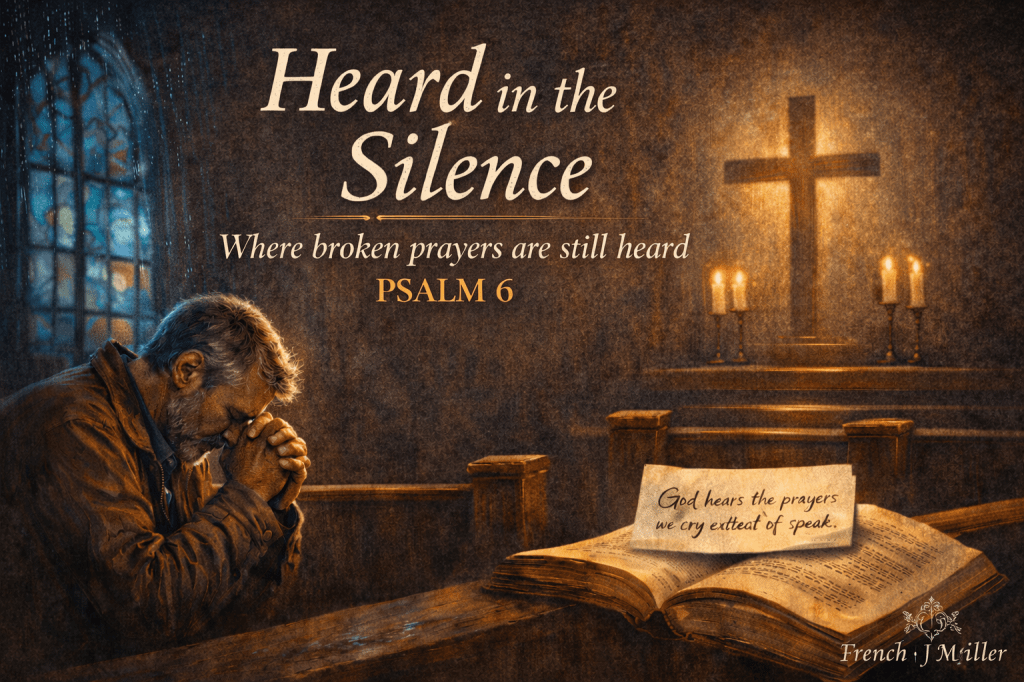
God hears the prayers we cry instead of speak.
Eli stared at it, his eyes blurring.
Clara’s voice was gentle. “People think faith means you never break,” she said. “But faith… faith is just refusing to stop turning toward Him, even when you’re limping.”
Eli swallowed hard. “I feel like I’ve been limping for months.”
Clara nodded. “I limped for years.”
Eli looked up, startled. “Years?”
Clara’s lips curved into something like a sad smile. “Grief doesn’t ask permission,” she said. “It moves in like family. Takes up a room. Eats at your table.”
Eli stared down at the paper again. His fingers trembled.
“I prayed,” he whispered. “I prayed so much. And she still..”
His voice broke, and he pressed the heel of his hand to his mouth.
Clara didn’t rush to fill the silence. She just sat there, letting him have it.
Finally, she said, “The Psalm doesn’t end where it begins.”
Eli glanced up.
Clara opened her Bible and turned pages with practiced familiarity. “Here,” she said, reading softly. “ ‘The Lord has heard the sound of my weeping.’”
Eli’s chest tightened.
Clara’s eyes lifted to his. “It doesn’t say the trouble vanished,” she said. “It says… He heard.”
Eli’s voice came out rough. “I don’t feel heard.”
Clara nodded as if she’d expected that. “Sometimes being heard doesn’t feel like fireworks,” she said. “Sometimes it feels like… not being alone in the dark.”
Eli stared at the cross again, then down at the paper in his hands.
He realized his fingers were digging into it like a lifeline.
Clara’s voice softened further. “You don’t have to be polished with God, Eli,” she said. “You don’t have to sing pretty.”
Eli let out a shaky breath. “I used to,” he whispered. “I used to sing like it was easy.”
Clara smiled faintly. “Then sing ugly,” she said. “He can handle it.”
Eli’s eyes stung. A laugh escaped him, small, surprised, wet with tears. “Sing ugly,” he repeated.
Clara nodded. “Pray ugly. Cry ugly. Whatever it takes to keep talking.”
Eli stared at the paper again. The note at the bottom felt like it had been written for him.
God hears the prayers we cry instead of speak.
He looked up at Clara, voice trembling. “What if… what if I’m angry?”
Clara didn’t flinch. “Tell Him,” she said.
Eli swallowed. “What if I feel like… like I did everything right and still got crushed?”
Clara’s eyes were kind. “Tell Him.”
Eli’s jaw tightened. “What if I’m afraid He’ll punish me for saying it wrong?”
Clara shook her head. “He already carried the punishment,” she said, glancing at the cross. “You can’t offend Him with honesty.”
Eli’s hands trembled. He stared at the pulpit, then the cross, then the empty pews.
The church felt less like a stage now and more like a shelter.
He stood slowly, the paper still in his hand.
Clara watched him without moving.
Eli took a step toward the altar rail, then stopped.
His throat tightened as if someone had tied a rope around it.
He whispered, “God…”
The word itself felt like opening a door that had been stuck for months.
He took another breath.
“I don’t even know what to say,” he admitted, voice cracking.
And then the words came, not neat, not rehearsed, but real.
“I’m tired,” he whispered. “I’m so tired.”
The tears started again, but this time he didn’t fight them.
“I miss her,” he said, voice rising and breaking. “I miss Rachel. I miss the way she laughed. I miss the way she used to hum while she cooked. I miss… I miss the weight of her hand in mine.”
His knees weakened, and he gripped the rail.
“I prayed,” he choked. “I prayed and begged and trusted You, and she still died.”
The sanctuary was silent except for his sobbing, but he kept going, because stopping felt like drowning.
“I know You’re God,” he whispered fiercely. “I know You’re good. I’ve told everyone You’re good. I’ve sung it, I’ve preached it with my life..”
His voice dropped.
“But I don’t understand.”
He pressed his forehead against his arm, tears soaking his sleeve.
“How long?” he whispered, the question of Psalm six finally leaving his chest the way it had lived there.
“How long am I going to feel like this? How long am I going to wake up and reach for someone who isn’t there? How long are You going to feel far away?”
His breath came in ragged waves.
Then, quieter, almost ashamed:
“Did You hear me?”
He waited.
Nothing thundered.
No voice filled the room.
But something happened anyway.
It was small, so small he almost missed it.
A loosening.
Like a fist unclenching inside his chest.
Like air reaching a place that had been sealed off.
Eli lifted his head slowly, wiping his face, confused by the sudden softness that had settled over him.
The pain was still there. It didn’t vanish. Grief didn’t evaporate like mist.
But it felt… held.
He looked toward the cross, and this time it didn’t feel like a reminder of what God hadn’t done.
It felt like a reminder of what God had already endured.
He exhaled shakily.
Behind him, Clara’s voice was a whisper. “That’s it,” she said, not praising, just acknowledging. “That’s the prayer.”
Eli turned, eyes red. “I don’t feel fixed,” he said.
Clara nodded. “Psalm six isn’t about being fixed,” she replied. “It’s about being heard.”
Eli stared at her, then back at the sanctuary.
The light hum seemed less harsh now. The stained glass looked softer.
The air still smelled the same, but now it also smelled like something else, like morning might exist again.
Clara stood slowly, her joints protesting, and walked toward him.
She didn’t touch him, didn’t invade his grief.
She simply stood beside him and looked at the cross.
For a moment they were quiet together.
Then Clara spoke, her voice steady. “When my Harold died,” she said, “I prayed Psalm six so many nights I could’ve recited it backwards.”
Eli swallowed. “Did it help?”
Clara’s eyes shimmered. “Not like I wanted,” she said. “But it kept me talking. And sometimes… that’s the difference between living and just existing.”
Eli nodded slowly.
Clara folded her hands. “You’ll still have nights,” she said. “The Psalm doesn’t promise no more nights.”
Eli’s jaw tightened. “I know.”
Clara’s gaze softened. “But it does promise you’re not praying into nothing,” she said. “Even when it feels like it.”
Eli’s throat tightened again, but he nodded.
Clara stepped back. “I should go,” she said. “It’s late.”
Eli looked down at the paper in his hand. “Can I keep this?”
Clara smiled faintly. “I brought it for you,” she said.
Eli held it tighter, as if afraid it might dissolve.
Clara started up the aisle, slow and steady.
At the doors, she paused and glanced back.
“One more thing,” she said.
Eli looked up.
Clara’s eyes were kind, but there was steel underneath the kindness.
“Don’t punish yourself for still hurting,” she said. “Grief is love with nowhere to go. Let it go to God.”
Eli nodded, unable to speak.
Clara opened the door and slipped into the hallway, her footsteps fading into the quiet.
Eli was alone again.
But it didn’t feel the same as before.
He returned to the pew and sat down, the paper resting on his lap.
He read the verses again, slower this time:
The Lord has heard the sound of my weeping…
His eyes drifted shut, and he let the words sink into the places that had been numb.
He didn’t feel joy.
Not yet.
But he felt something else.
A thin thread of peace.
Not enough to erase the ache, but enough to keep him from falling apart completely.
Outside, rain tapped against the stained glass.
Inside, Eli’s breathing steadied.
After a while, he opened his eyes and glanced at the hymns book.
On impulse, he reached for one, dusty, unused, and opened it to a hymn he hadn’t touched since Rachel’s funeral.
The pages rustled like wings.
His voice was rough when he tried to sing, barely more than a whisper. The note cracked.
It wasn’t pretty.
It was… honest.
He sang anyway, one line at a time, the sound floating into the empty sanctuary like an offering from a broken place.
When he finished, he sat quietly, the last note fading.
He looked at the cross again.
And this time, he didn’t ask God to prove He was there.
He simply whispered, “Thank You for hearing me.”
The prayer didn’t feel loud.
But it felt real.
And for the first time in months, Eli believed that might be enough to start with.
Morning would come when it came.
For now, he had the night, the Psalm, and the quiet certainty that somewhere beyond his tears, God had not turned away.
Not from Rachel.
Not from him.
Not from this weary, honest prayer.
He glanced down at Clara’s note one more time.
God hears the prayers we cry instead of speak.
Eli let out a slow breath.
Then, with his keys in hand and the paper folded carefully into his pocket like a promise, he stood up and walked toward the doors, still grieving, still limping…
but still turning toward God.
Note From the Author
Psalm 6 has always been one of the most honest prayers in Scripture. It doesn’t rush toward resolution or dress pain up in polished faith. It asks the question many believers are afraid to speak out loud: How long, Lord?
In 2021, I walked through a season of deep grief following the death of my wife. In that time, faith did not disappear, but it changed. Prayer became quieter. Words came slower. Some days, all I could offer God was silence, tears, or a question without an answer.
Psalm 6 met me there.
It reminded me that Scripture makes room for sorrow, exhaustion, and unanswered prayers. That faith does not require strength to be real. That God does not turn away from grief, but listens to it.
Heard in the Silence was born from that place. This story is not about having the right words or reaching quick healing. It is about continuing to turn toward God even when the heart is heavy and hope feels distant.
If you are walking through loss, doubt, or a season where prayer feels fragile, this story is for you. Psalm 6 assures us that even when we can barely speak, God still hears.



 24/7 Of Praise
Leave a comment