We like our lines clean.
Good people on one side.
Bad people on the other.
Heroes and villains, righteous and ruined, light and dark, clearly separated so we know where we stand.
But real life refuses to stay that neat.
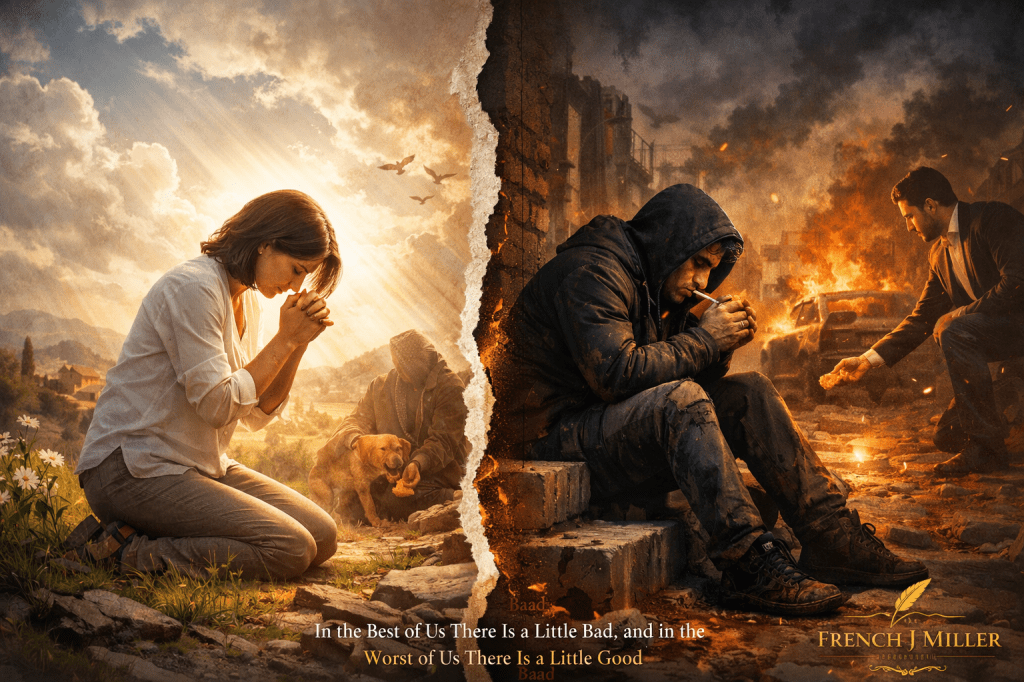
In the best of us, there is a little bad.
And in the worst of us, there is a little good.
That truth is uncomfortable because it won’t let us hide behind labels.
The person who shows up every Sunday, quotes Scripture, and speaks kindly can still carry pride, bitterness, or quiet judgment in their heart. The one who gives generously may struggle with control. The one who appears strong in faith may battle secret doubts they’re afraid to name.
And yet,the one we’re quickest to dismiss, the one whose life looks broken, reckless, or morally off course, often carries moments of unexpected kindness. A soft spot. A loyalty. A compassion that surfaces when no one is watching.
We are rarely as pure as we think we are, and almost never as lost as we fear we might be.
This is why humility matters.
When we recognize the little bad in ourselves, we stop pretending. We stop performing righteousness and start practicing repentance. We become less shocked by our own failures and more dependent on grace instead of image. Humility doesn’t excuse sin—it simply tells the truth about the human condition.
And when we recognize the little good in others, even in those who’ve fallen far, we leave room for redemption. We stop writing people off as finished stories. We stop assuming that one chapter defines the whole book.
Scripture understands this tension well. It never presents humanity as entirely good or entirely evil. Instead, it tells the truth: we are fractured beings made in the image of God, capable of love and cruelty, faith and fear, obedience and rebellion, all at the same time.
That’s why grace is not a reward for the best of us.
It’s a necessity for all of us.
If goodness alone were enough, we wouldn’t need mercy.
If brokenness were final, redemption would be impossible.
But the heart of the gospel lives right in this paradox: God meets us not as we imagine ourselves to be, but as we truly are. Flawed. Contradictory. Wounded. Capable of both harm and healing.
When we forget this, we grow harsh toward others and toward ourselves. We judge quickly. We lose patience. We demand perfection from people who are still in process.
But when we remember it, something shifts.
We become slower to condemn and quicker to listen.
We correct without cruelty.
We hold convictions without losing compassion.
And perhaps most importantly, we stop being surprised by the struggle.
The presence of “a little bad” in a good person doesn’t mean faith has failed; it means growth is still happening. And the presence of “a little good” in a broken person doesn’t mean sin is harmless; it means hope is still alive.
This truth doesn’t blur the line between right and wrong.
It deepens it, with mercy.
Because the goal was never to prove who is better.
The goal was always restoration.
In the end, recognizing the mixture within us all doesn’t weaken faith; it strengthens it. It reminds us why we need grace daily, why forgiveness matters, and why no one is beyond the reach of redemption.
In the best of us, there is a little bad.
In the worst of us, there is a little good.
And it is precisely there, in that tension, that grace does its most powerful work.



 24/7 Of Praise
Leave a comment