During the month of February, I have written about how Black history has been hidden, softened, or erased altogether, how uncomfortable truths are often buried beneath carefully chosen words and selective remembrance. But racial injustice is not the only history that has been edited for public comfort. There is another kind of erasure that rarely gets named: the moments when power rewrites tragedy, when the loss of innocent life is reduced to language that protects institutions instead of honoring victims. This story is about one of those moments,an event our history prefers to remember as an accident, even as its consequences continue to shape the world we live in today.
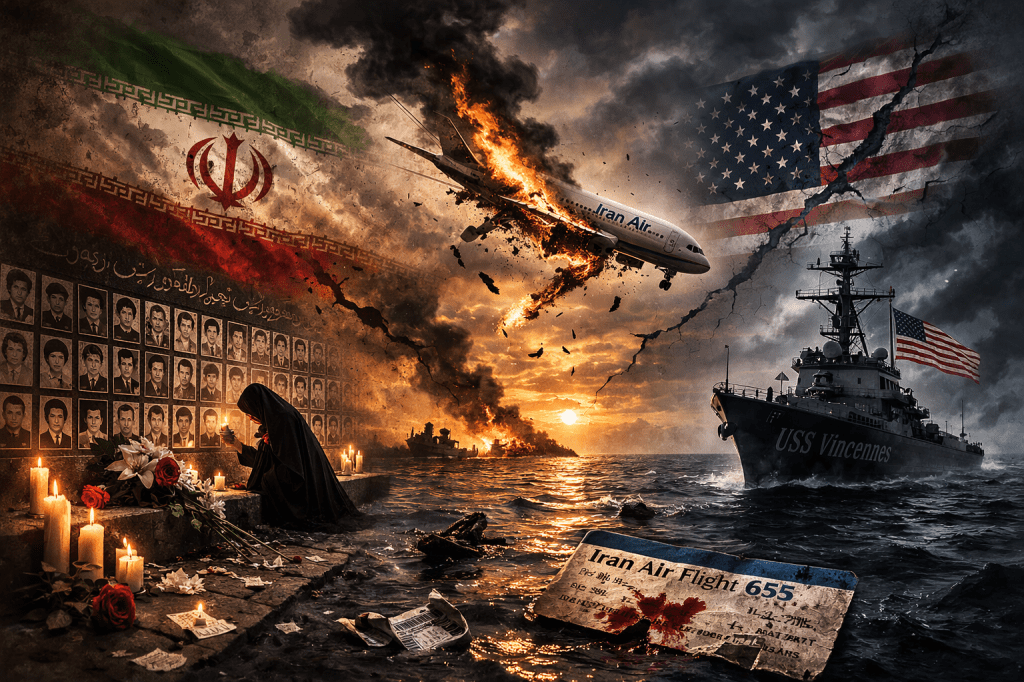
On a summer morning in 1988, one of the most tragic and controversial events in modern U.S., Iran relations unfolded over the Strait of Hormuz. Iran Air Flight 655, a civilian passenger jet carrying 290 innocent civilians, was shot down by the U.S. Navy warship USS Vincennes in the midst of the Iran-Iraq War, a conflict already rife with tension, fear, and deadly miscalculations.
That single moment, a civilian plane lost in combat chaos, did more than take lives. It became a defining symbol of mistrust and resentment between Tehran and Washington that still echoes in policy decisions, diplomatic stagnation, and public perception nearly four decades later.
What Happened That Day
On July 3, 1988, Iran Air Flight 655 was following a routine commercial route from Bandar Abbas, Iran, to Dubai. It was an Airbus A300 climbing steadily when operators aboard the USS Vincennes, a U.S. missile cruiser patrolling the volatile Persian Gulf, misidentified the aircraft as a hostile Iranian military jet. Acting on that mistaken assessment amid tense naval engagements with Iranian patrol boats, the Vincennes launched missiles that destroyed the airliner, killing all crew and passengers.
The U.S. government immediately framed the incident as a tragic mistake made in the fog of war, expressing “deep regret” for the loss of life but stopping short of admitting legal fault or intentional wrongdoing. President Ronald Reagan’s administration and later officials described it as a “terrible human tragedy” rather than a criminal act.
Iran’s Reaction: Not an Accident, But an Atrocity
In Tehran, however, the perception was starkly different. Iranian leaders condemned the shootdown as a criminal action and criminal negligence rather than an unfortunate accident. At the United Nations Security Council, Iran’s foreign minister accused the United States of deliberately targeting civilians and violating international norms, calling the attack a “criminal act,” “massacre,” and “atrocity.”
For many in Iran, especially government officials and hard-liners, this was not just a tragic mistake but evidence of a pattern of U.S. disregard for Iranian lives. The timing worsened existing tensions, coming on the heels of full-scale proxy and naval disputes in the Gulf, and reinforced the Iranian narrative that the United States was willing to use overwhelming force with little accountability.
A Dispute That Never Fully Resolved
The dispute even made its way to the International Court of Justice in a lawsuit brought by Iran against the United States, which accused Washington of violating aviation and international safety conventions. The case ended in 1996 with the U.S. agreeing to pay $131.8 million in compensation to the families of the victims, but in doing so, the U.S. never admitted legal liability.
That distinction, regret versus responsibility, would become one of the core reasons the incident continues to be a point of contention. For many Iranians, the compensation was insufficient without an acknowledgment of wrongdoing; for many Americans, the tragedy is seen in the context of mistaken identification in a war zone. The very different narratives hardened perceptions on both sides.
Why It Matters for U.S.–Iran Relations Today
Looking back at the broader arc of U.S.-Iran relations, the Iran Air 655 shootdown represented far more than a single moment of misfortune.
In the United States, the event has often been treated as a footnote, another example of the dangers inherent in military operations. But in Iran, it became part of the foundational story of U.S. hostility. Alongside other sources of grievance, including the 1953 coup against Iran’s democratic government and later sanctions and military confrontations, the shootdown has been cited by Iranian officials as proof of a long pattern of American disregard and aggression.
Even generations later, leaders in Tehran still reference the incident when framing critiques of U.S. policy. Rather than seeing it as a tragic accident, many Iranian political actors incorporate it into a narrative that the United States cannot be trusted, that its military might trumps civilian safety, and that American apologies are hollow without accountability.
Would It Be Different Today?
It is telling to consider how differently the political language might sound if the roles were reversed — if American passengers aboard a civilian airliner were killed by a foreign military. In the modern era, such an incident would likely be called an act of terrorism or an unacceptable provocation, demanding swift diplomatic or legal action. Many analysts argue that the relative softness of the U.S. official response in 1988, calling it a tragedy instead of an unlawful act, contributed to perceptions of double standards. Even now, that perception fuels animosity and distrust in the Middle East and beyond.
In the years since, U.S.-Iran relations have swung from ice to fire and back again, shaped by wars, nuclear negotiations, sanctions, and proxy conflicts. Yet the anniversary of Iran Air Flight 655 remains a reminder of how swiftly tragedy can become history, and how lasting the consequences can be when two nations tell very different stories about the same event.
How Iran Air Flight 655 Is Remembered — and Why the Memory Gap Matters
The destruction of Iran Air Flight 655 is one of those historical events that have not faded with time. Instead, it hardened into two very different national memories, each shaped less by facts than by framing, language, and accountability. How the incident is taught and remembered in the United States versus Iran helps explain why the wound never closed, and why mistrust between the two nations remains so deep.
In the United States, the downing of Flight 655 is rarely taught in depth. When it does appear in textbooks, military studies, or public discourse, it is almost always framed as:
A tragic accident
A case study in the fog of war
An example of misidentification during high-stress military operations
The language used is telling. Official U.S. statements emphasized regret and mistake, not wrongdoing. The ship involved, USS Vincennes, was described as acting defensively. The crew was not criminally charged, and the ship’s commanding officer later received commendations for service, a fact that is often overlooked domestically but never forgotten abroad.
As a result, the event occupies little cultural or emotional space in American public memory. There are:
- No national memorials
- No annual moments of remembrance
- No widespread public acknowledgment beyond brief historical references
For many Americans, Flight 655 is simply an obscure Cold War-era footnote, tragic, yes, but distant and abstract.
In Iran: A National Trauma and Moral Indictment
In Iran, the memory could not be more different.
The downing of Flight 655 is taught as a deliberate and unjustifiable act, regardless of U.S. claims of mistake. It is remembered not just as a loss of 290 lives, but as proof of American impunity, a moment when civilian deaths were acknowledged rhetorically but never fully owned.
In Iranian schools, media, and political discourse, the incident is often described as:
- A massacre of civilians
- A violation of international law
- A symbol of double standards in global justice
The victims are named, remembered, and mourned. Memorials exist. Anniversaries are observed. State media revisit the event regularly, especially during periods of heightened tension with Washington.
What matters most in Iranian memory is not only what happened, but what followed:
- No formal admission of guilt
- No criminal accountability
- Compensation paid without legal responsibility
To many Iranians, this confirmed a long-held belief: that Iranian lives were treated as expendable on the world stage.
Two Stories, One Event
This divergence in memory is not accidental; it is the product of language and power.
In the United States, the event is softened by institutional framing: tragic, unfortunate, accidental. In Iran, it is sharpened by lived loss and unresolved grievance.
That difference feeds a larger pattern:
- Americans often see Iranian distrust as irrational or ideological
- Iranians see it as historical and earned
When Iranian leaders cite Flight 655 decades later, it is not mere propaganda; it is a reminder of a moment when the global system, in their view, failed them. This unresolved divide in memory helps explain why today’s headlines between the United States and Iran escalate so quickly and de-escalate so poorly. When Washington speaks of deterrence, accidents, or misunderstandings, Tehran hears echoes of 1988, a moment when 290 civilians died, and the world moved on. Each new naval confrontation, sanction, or military strike is filtered through that history. Until both nations confront not just what happened, but how it has been remembered, the past will continue to sit quietly behind the present, turning every crisis into proof that the other side never truly learned the lesson.

 24/7 Of Praise
Leave a comment