
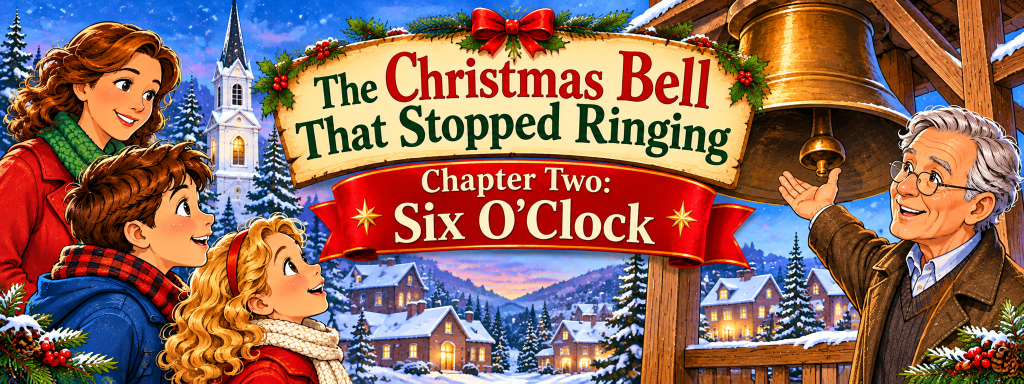
A Christmas Story by French J. Miller
The people of Evergreen Falls had a way of knowing when Christmas was getting close.
It wasn’t simply the decorations appearing in shop windows or the evergreen wreaths hanging from front doors. It wasn’t the smell of cinnamon rolls drifting from Patterson’s Bakery, or the sound of Christmas music coming from the little radio behind the counter at the hardware store. Those things were part of the season, certainly, but they weren’t what made Christmas feel complete.
In Evergreen Falls, Christmas had a sound of its own.
It was the sound of a bell.
Every Christmas Eve, just as the town clock reached six o’clock, the great brass bell in the tower of Evergreen Community Church rang twelve times. The sound rolled over the rooftops, traveled down Main Street, and carried across the snow-covered hills surrounding the town. People paused wherever they happened to be. Shopkeepers stepped outside. Families gathered at their windows. Children stopped playing long enough to count each ring.
Twelve clear notes. One for every month of the year.
It was a tradition older than anyone living in Evergreen Falls could remember, and most people had grown up believing it would continue forever.
Samuel Whitmore had heard the bell every Christmas Eve of his life. Until recently, he had never given much thought to how it worked, who had started the tradition, or why the town had chosen six o’clock. Those details had seemed about as important as knowing who first decided that Christmas trees should have lights.
But Samuel had begun to wonder.
And when Samuel began to wonder about something, questions usually followed.
* * *
The following Saturday, with only eight days left until Christmas, Samuel sat at the kitchen table with a bowl of cereal in front of him and a pencil in his hand. His things-to-do-before-Christmas list had been pushed aside. He had taken a fresh sheet of paper from his school notebook and written three questions across the top.
Why does the bell ring at six o’clock?
Why does it ring twelve times?
Who started the tradition?
He stared at the questions, tapping the pencil against the table.
Across from him, Lily was carefully arranging three pieces of toast into what she claimed was a Christmas tree. The smallest piece sat on top, the largest at the bottom, and a strawberry slice served as the star.
“That’s not a Christmas tree,” Samuel said.
Lily looked up. “It is if you use your imagination.”
“It looks like a sandwich.”
“That’s because you don’t have enough imagination.”
Their mother, Margaret, smiled as she poured herself another cup of coffee. “I think it looks very festive.”
“Thank you,” Lily said, giving Samuel a satisfied look.
Samuel returned his attention to his paper.
David Whitmore came into the kitchen carrying a small toolbox. He had been working on the front porch decorations and had apparently discovered another problem with the lights.
“What’s all that?” he asked, noticing the paper.
“Questions.”
“That much I figured out.”
Samuel turned the page toward him. “I’m trying to find out about the church bell.”
David glanced at the questions. “The bell?”
“Why it rings at six o’clock. Why twelve times. Who started it.”
“Those are good questions,” his father replied.
“Do you know the answers?”
David considered that for a moment. “I know the bell has been part of the town’s Christmas Eve tradition for a very long time. Your grandfather used to talk about hearing it when he was a boy.”
“But who started it?”
“That, I’m afraid, I don’t know.”
Samuel looked disappointed.
“Perhaps you should ask Mr. Carter,” Margaret suggested. “He knows more about the church and its history than anyone.”
“I did,” Samuel said. “Last Saturday. He told me ’perhaps another time.’”
Margaret smiled. “Then maybe another time has arrived.”
Samuel immediately picked up his pencil and added another question.
What does Mr. Carter know?
Lily leaned over to read it.
“That’s not a very nice question,” she said.
“Why?”
“Because it sounds like you’re investigating him.”
“I’m investigating the bell.”
“Well, maybe you should tell him that before you start asking questions.”
Samuel sighed. “I know how to ask questions, Lily.”
She took another bite of her toast tree. “You certainly do.”
* * *
Later that morning, Samuel and Lily walked down Main Street with their mother. The snow from earlier in the week had settled along the edges of the sidewalks, leaving the center paths clear. Shop windows glowed with Christmas decorations, and a light breeze sent small flakes drifting from the branches of the evergreens lining the street.
A wooden sign outside Patterson’s Bakery announced that the gingerbread was fresh from the oven.
Lily stopped immediately.
“Can we go inside?”
“We just had breakfast,” Margaret reminded her.
“That was a long time ago.”
Samuel checked his watch. “It was two hours and seventeen minutes ago.”
Lily gave him a look. “You don’t have to keep track of everything.”
Mrs. Eleanor Patterson was behind the counter when they entered. She was a cheerful woman with silver hair, bright eyes, and an apron dusted with flour. The bakery smelled of fresh bread, cinnamon, and something sweet that Samuel couldn’t quite identify.
“Well, look who’s here,” she said. “My two favorite Christmas visitors.”
“Do you have gingerbread cookies?” Lily asked.
Mrs. Patterson reached beneath the counter and brought out a tray. “I thought someone might ask.”
Lily smiled.
Samuel looked toward the wall behind the register, where he had noticed the old photograph of the church the week before. Several other pictures hung beside it in mismatched wooden frames. The church photograph was old enough that its edges had turned brown, and the people in it wore heavy coats, long skirts, and hats. A large evergreen wreath hung above the church doors, and one man near the front still held the long bell rope.
“Mrs. Patterson?”
“Yes, Samuel?”
“Do you know when the church bell tradition started?”
Her expression changed slightly, although her smile remained.
“That’s a question I haven’t heard in a while.”
“Do you know?”
“I know pieces of the story. My grandmother used to tell it to me when I was little.”
Samuel pulled the folded paper from his pocket.
Lily shook her head. “You brought your questions?”
“Of course.”
Mrs. Patterson laughed softly. “Well, let’s hear them.”
Samuel unfolded the paper and began with the first question.
“Why does the bell ring at six o’clock?”
Mrs. Patterson rested her hands on the counter. “That’s a good place to begin. My grandmother always said six o’clock was chosen because it was the hour when families were supposed to be gathering together on Christmas Eve. The work of the day was finished, supper was being prepared, and people were beginning to settle in for the evening.”
“So the bell was a reminder?” Samuel asked.
“That’s how she explained it. A reminder to stop what you were doing and remember what Christmas was about.”
Lily looked up from her cookie. “Being with your family?”
“That was part of it,” Mrs. Patterson said. “But I think there was more to it than that.”
Samuel glanced at his second question.
“Why twelve times?”
Mrs. Patterson looked toward the church visible through the bakery window.
“One ring for each month of the year. A reminder that the kindness of Christmas shouldn’t be something we practice for only one day.”
Samuel wrote that down.
“Who started the tradition?”
Mrs. Patterson grew quiet.
“That part of the story is a little harder to explain.”
“Why?”
“Because the people who first began it are long gone. The story was passed from one generation to the next. Some details became clearer with time, while others were forgotten.”
“Do you remember what your grandmother said?”
She looked at him for a moment before answering.
“I remember that she always said the bell began with a promise.”
“A promise?” Samuel repeated.
Mrs. Patterson nodded. “A promise that no one should have to spend Christmas feeling forgotten.”
Lily lowered her cookie.
“That’s sad,” she said.
“It can be,” Mrs. Patterson replied gently. “But the story isn’t sad, sweetheart. Not all of it.”
Samuel was about to ask another question when Mrs. Patterson glanced at the old photograph on the wall.
“Mr. Carter may be able to tell you more. He has spent many years looking after that church.”
“That’s what Mom said.”
“Then your mother is giving you very good advice.”
Samuel folded his paper, but he kept looking at the photograph.
“Who are those people?”
Mrs. Patterson followed his gaze.
“Some of the families who lived here long ago. My grandmother might have known a few of them.”
“Do you know which one started the bell tradition?”
Mrs. Patterson studied the photograph again.
“I don’t know, Samuel. But there is one person who might.”
“Mr. Carter?”
She nodded.
* * *
By early afternoon, Samuel had decided that asking Mr. Carter about the bell was more important than anything else he had planned for the day.
Lily, on the other hand, had decided that the gingerbread cookie she had bought at the bakery was the best cookie in Evergreen Falls. She was still eating the last few crumbs as they approached the church with their mother.
The church stood on its small hill at the far end of the square. Its white wooden walls rose beneath a tall steeple, and a narrow path led from the sidewalk to the front steps, where a wreath decorated the double doors.
The bell tower stood above everything, its dark opening visible beneath the pointed roof.
Samuel stopped and looked up.
“I wonder how big it is.”
Margaret followed his gaze. “Probably bigger than you think.”
“Could we see it?”
“That depends on whether Mr. Carter is here and whether he has time.”
As if summoned by the question, the church’s side door opened.
Benjamin Carter stepped outside carrying a small wooden box. His round spectacles had slipped halfway down his nose, and his work jacket was worn at the elbows. His face seemed to carry a little piece of every winter he had lived through.
He spotted the Whitmores and raised a hand.
“Good afternoon.”
“Hello, Mr. Carter,” Margaret called.
“Mrs. Whitmore. Good to see you.”
His eyes moved to Samuel and Lily.
“And what brings these two visitors to the church today?”
Samuel stepped forward.
“I have more questions about the bell. I wrote them down this time.”
Mr. Carter smiled. “I wondered how long it would take you to come back.”
Samuel looked surprised. “You did?”
“Your eyes have been following that tower every time you’ve walked past the church. A person doesn’t have to be a detective to notice.”
Lily giggled.
“You said ’perhaps another time,’” Samuel reminded him.
“So I did.”
Samuel pulled his paper from his pocket. “I want to know why the bell rings at six o’clock, why it rings twelve times, and who started the tradition.”
Mr. Carter glanced at the paper.
“That’s quite a list.”
“I’ve been adding to it.”
“I can see that.”
He set the wooden box on a nearby bench and brushed his hands together.
“Well, I suppose we can talk about it for a little while.”
Samuel’s face brightened.
“Does that mean we can see the bell?”
“One question at a time, young man.”
Mr. Carter led them through the side door and into the church.
The sanctuary was quiet. Colored light from the stained-glass windows stretched across the wooden pews, and a small evergreen wreath hung above the pulpit. The room smelled faintly of polished wood and pine.
Lily walked slowly down the aisle, looking around.
“It’s pretty,” she whispered.
“It is,” Margaret agreed.
Mr. Carter stopped near the front of the sanctuary.
“The bell has been here for more than a hundred years,” he began. “It was brought to Evergreen Falls when the church was still a much smaller building. The town has changed considerably since then, but the bell has remained.”
“Has it always rung on Christmas Eve?” Samuel asked.
“As far as the records show, yes.”
“Even during storms?”
“Even during storms.”
“Even when it snowed a lot?”
Mr. Carter smiled. “Especially when it snowed a lot. There have been Christmas Eves when the roads were covered and the snow came nearly to the church steps. The bell could still be heard across town.”
“Who rings it?”
“Someone has always been responsible for making sure it rings. For the past thirty-two years, that responsibility has belonged to me.”
Samuel looked impressed.
“Thirty-two years?”
“That’s right.”
“Have you ever missed it?”
Mr. Carter’s expression became thoughtful.
“Never.”
The answer was quiet but certain.
He turned toward the large wooden door near the side of the sanctuary.
“The bell itself is in the tower. There are steps leading up to the work platform, but they’re narrow and steep. It isn’t a place for visitors, especially children.”
Samuel looked disappointed, but he nodded.
“Can you show us how it works?”
“I can show you what I can from here.”
Mr. Carter opened a small door in the wall beside the sanctuary. Inside was a section of the old bell mechanism, including a heavy rope that disappeared upward through the ceiling.
“This is connected to the bell,” he explained. “When the rope is pulled, the bell swings and the clapper strikes the inside.”
Samuel leaned closer, careful not to touch anything.
“So you pull it twelve times?”
“Not exactly. The bell swings back and forth, and the clapper strikes as it moves. You have to know how to control the rhythm. Too fast, and the rings run together. Too slow, and the pauses become too long.”
“How do you know when to stop?”
“Experience.”
“Thirty-two years of experience?”
“Thirty-two years of experience.”
Lily looked at the rope.
“Does it ever get tired?”
Mr. Carter chuckled. “The bell?”
She nodded.
“I suppose it might if it had feelings. But brass is a little more dependable than the rest of us.”
Lily smiled.
Samuel was still studying the mechanism.
“Why six o’clock?”
Mr. Carter rested one hand against the wooden frame.
“Because that was the hour when the original promise was remembered. The bell was meant to call the town together, to remind people that Christmas was about more than presents, decorations, and a good meal.”
“Mrs. Patterson said it started with a promise,” Samuel said.
Mr. Carter looked at him.
“She told you that?”
“She said the promise was that no one should have to spend Christmas feeling forgotten.”
For several seconds, Mr. Carter said nothing.
Then he nodded.
“Eleanor Patterson’s grandmother knew the story well,” he said at last, almost to himself.
“What was the promise about?” Samuel asked.
Mr. Carter looked toward the stained-glass windows. The afternoon light had begun to fade, and the colors across the pews were growing softer.
“That is a story worth hearing,” he said.
“Can you tell us?”
“Some of it.”
“Why only some?”
“Because stories are best understood when you know where they begin. And I think you still have a little more to learn about the bell before we get to that part.”
Samuel frowned slightly. He didn’t like being told there was more to learn without being told what it was.
Lily, however, seemed satisfied.
“Maybe the story is a surprise,” she said.
“Maybe,” Mr. Carter replied.
Before they left, Mr. Carter walked them back toward the side entrance.
Samuel stopped beside a small wooden table near the church office. An old framed photograph rested on it, partly hidden beneath a stack of folded papers.
It showed the church as it had looked many years earlier. The building was smaller, the steeple slightly different, and the surrounding trees much younger.
But it wasn’t the church that caught Samuel’s attention.
It was a little boy standing near the front steps.
He wore a dark coat that was too large for him and a scarf wrapped around his neck. Beside him stood an older man in a heavy winter coat. The man had one hand resting on the boy’s shoulder.
Samuel leaned closer.
“Who are they?”
Mr. Carter followed his gaze.
For a moment, the old caretaker seemed to forget that anyone else was in the room.
“Where did you find that?” he asked.
“Right there.”
Mr. Carter picked up the photograph carefully. His thumb brushed the edge of its wooden frame.
“That’s a very old picture.”
“Who is the boy?” Samuel asked.
Mr. Carter looked at the photograph again.
“Someone who lived here a long time ago.”
“Is he the one who started the bell tradition?”
“Perhaps.”
“What’s his name?”
Mr. Carter turned the photograph slightly, as though looking at it from another angle might help him decide what to say.
“His name was Thomas.”
Samuel waited.
“And the man?”
Mr. Carter’s eyes moved to the older figure beside the boy.
“That,” he said quietly, “is part of the story.”
He placed the photograph back on the table, making sure it was straight.
“Some things are easier to understand when you know the people involved.”
Samuel wanted to ask what he meant, but Mr. Carter had already turned toward the door.
“Come along. Your mother is waiting.”
Lily took Samuel’s hand as they stepped outside.
“Who do you think Thomas was?” she whispered.
“I don’t know.”
“Do you think he was a good boy?”
Samuel glanced back at the church.
“I think he might have been an important boy.”
Lily considered that.
“Maybe he was both.”
* * *
The sun had disappeared behind the mountains by the time the Whitmores reached home. The evening settled over Evergreen Falls, and lights began to appear in the windows of the houses along the street.
After supper, Samuel sat in the living room with his notebook open on his lap. His mother was reading beside the fireplace, and Lily was on the floor arranging a collection of Christmas ornaments into what she called a holiday village.
Samuel had added several new notes to his list.
The bell is more than 100 years old.
It rings twelve times, one for each month.
Mr. Carter has rung it for 32 years and has never missed.
He paused, then wrote another line.
The tradition began with a promise.
He stared at those words for a while.
“What are you thinking about?” Margaret asked.
“The boy in the photograph. Thomas.”
“Mr. Carter showed you the picture?”
Samuel nodded. “He said Thomas might have been the one who started the tradition.”
“That sounds interesting.”
“He wouldn’t tell me who the man was.”
“Perhaps he didn’t know.”
“I think he knows.”
Margaret lowered her book.
“Why do you think that?”
“Because when he looked at the photograph, he acted differently. Like he remembered something.”
His mother considered that.
“Sometimes people have memories they aren’t ready to share, Samuel.”
“But why wouldn’t he tell us?”
“Maybe he wants to make sure the story is told properly.”
Samuel looked down at his notebook.
He wasn’t convinced, but he understood what she meant.
Across the room, Lily held up a small wooden angel ornament.
“Samuel, where should I put this?”
“Wherever you want.”
“That’s not helpful.”
“Then put it at the top.”
“That’s where the star goes.”
Samuel returned to his notes.
Lily placed the angel beside the little wooden church in her holiday village. Then she sat back on her heels, studying the arrangement.
“I think there should be a person beside the church,” she said.
“Why?”
“Because a church is a place for people.”
Samuel looked at her.
“That’s true.”
“And if there isn’t anyone there, it looks lonely.”
She found a small wooden figure and placed it beside the church door.
“There. Now someone is waiting.”
Samuel smiled and returned to his notebook.
He had one final question to add.
What happened to Thomas?
* * *
Back at the church, Benjamin Carter stood alone in his small office.
The sanctuary lights were off, and the last glow of daylight had long since faded from the windows. A desk lamp lit the papers spread across his desk.
The old photograph from the little table by the door lay in front of him.
He picked it up and studied the two figures standing outside the church. The boy’s coat was too large, his scarf was crooked, and his hair looked as though the winter wind had been playing with it.
The older man beside him appeared tired. His shoulders were hunched, and he had the look of someone who had traveled a very long way.
Mr. Carter turned the photograph over.
On the back, written in faded ink, were eight words:
Christmas Eve. Six o’clock. Room for one more.
He traced the writing with his finger.
For many years, the words had been part of the church’s history, but few people in Evergreen Falls knew what they meant. The old story had been passed down in pieces, and each generation seemed to remember a little less.
Mr. Carter opened the bottom drawer of his desk and took out a small bundle of papers tied with a narrow piece of ribbon.
He untied it carefully.
Among the papers was an old handwritten page, its edges worn and its ink faded. He had read it many times, yet the words seemed to carry a different weight whenever Christmas approached.
He placed the photograph beside it.
Then he looked toward the ceiling, where the bell rested in its tower above the quiet church.
“Thirty-two years,” he murmured.
He had rung that bell every Christmas Eve since taking over from his father. He had heard it echo across the town through blizzards, bitter cold, and winters when the snow seemed determined never to stop falling.
He had always believed the tradition would continue.
He had always believed the promise would be remembered.
But as he looked at the old photograph, he wondered how many people in Evergreen Falls still understood why the bell rang.
Outside, the town clock struck seven.
Mr. Carter folded the old paper and returned it to the drawer.
There was still time before Christmas Eve.
Still time to remember.
Still time to tell the story.
And somewhere in the tower above him, the great brass bell waited for the night when the entire town would listen.
Six o’clock. Twelve rings. One promise.
The people of Evergreen Falls had kept the tradition for generations.
But a tradition could be repeated long after its meaning had been forgotten.
And that, Mr. Carter feared, was exactly what had happened.
End of Chapter Two
The story continues next Friday with Chapter Three: “The Bell Stopped Ringing.”
A Christmas story by French J. Miller.




Leave a Reply